ZooProxy Shows How to Properly Select Native IP for SEO Business

2026-04-24 16:00
 Jack
Jack
As any SEO professional knows, data analysis lies at the very heart of daily operations. However, many encounter a common set of frustrations in practice: repeatedly checking keyword rankings from a single IP address triggers CAPTCHA challenges—or even results in a complete access ban; attempting to track a keyword’s performance across different cities yields only localized search results; and conducting competitive analysis through frequent visits to competitors’ websites leads to their IP addresses being blocked.
The root cause of these issues often lies in the fact that the IP addresses being used lack sufficient purity or precision. Today, drawing upon its product expertise, ZooProxy will guide you through the process of selecting the right Native IPs to optimize your SEO operations.
Why SEO Businesses Require Native IPs
Before addressing how to make a selection, it is essential to first understand why it is necessary.
Search engine algorithms determine a user’s geographical location based on their IP address and display localized search results accordingly. For instance, the search results for a specific keyword in Beijing and Shanghai may differ completely. If you monitor rankings solely from a single, fixed IP address, you effectively deprive yourself of the ability to capture multi-dimensional data.
Specifically, native IPs primarily address three key issues within the realm of SEO.
Obtain Authentic Localized Ranking Data
When serving international clients or conducting multi-regional SEO, you need to know exactly what users in your target market actually see. Unless you switch your IP address, search engines will continue to serve you search results based on your current location. Only by utilizing a native IP address from the target region can you accurately capture local search experience data.
Ensure the Continuity of Data Collection
When you need to perform bulk rank checks for a large volume of keywords—or frequently access competitor websites—high-frequency requests originating from a single IP address can easily trigger search engine risk control mechanisms, resulting in CAPTCHA prompts at the very least. By utilizing native IP rotation, you can effectively distribute the source of these requests.
Enhance the Accuracy of Data Collection
Using low-quality IPs—such as data center IPs that have previously been subject to abuse—to check search rankings will likely yield inaccurate data. Only by utilizing “clean” IPs can you ensure that the collected data is authentic and reliable.
Dimension 1: IP Purity
Does the IP originate from a legitimate ISP, and has it ever been associated with abuse? ZooProxy offers over 110 million legitimate residential IPs sourced from real ISPs worldwide—all of which comply with AUPs and are fully authorized.
Dimension 2: Regional Coverage
Does it cover the target market? Can it pinpoint locations down to the city level? ZooProxy covers over 195 regions and supports precise targeting at the city or state level.
Dimension 3: Stability
Disconnection rates and response latency directly impact the quality of data acquisition tasks. Real-world testing of ZooProxy demonstrates a network operational stability rate of 99.92%, with an average response time of less than 0.5 seconds.
Dimension 4: Ease of Access
Does it support API calls, and can it integrate seamlessly with existing toolchains? ZooProxy offers standard HTTP and SOCKS5 protocols, supporting integration across multiple languages such as Python, Java, and PHP.
Dimension 5: Billing Transparency
Are there any hidden costs? Is billing strictly pay-per-use? ZooProxy is committed to a pay-per-use model, with dynamic residential IPs starting as low as $0.49/GB and static ISP IPs starting at $1.80 per IP.
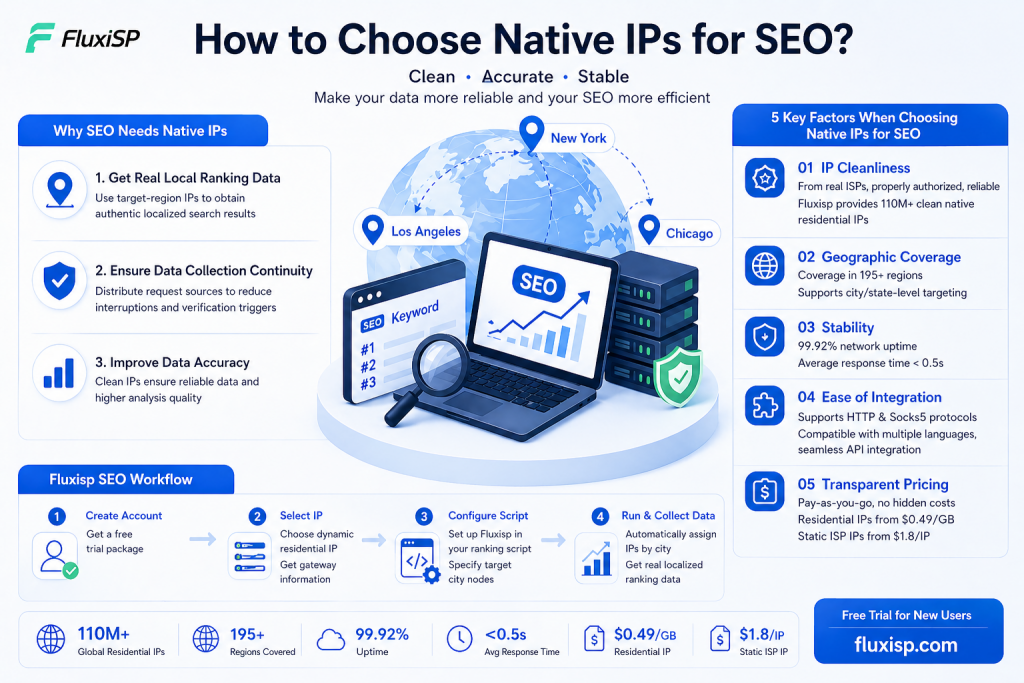
Integrating ZooProxy’s Practical SEO Workflow
Suppose you are an SEO agency serving the U.S. market and need to regularly monitor the Google rankings of 1,000 keywords across three cities: New York, Los Angeles, and Chicago. With ZooProxy, you can accomplish this as follows:
Step 1: Register for a ZooProxy account and claim your free trial package.
Step 2: In the dashboard, select “Dynamic Residential IPs” to retrieve your gateway details.
Step 3: Configure the ZooProxy proxy within your ranking monitoring script, specifying the specific city nodes you wish to target.
Step 4: Run the script; ZooProxy will automatically assign clean residential IPs corresponding to the designated cities, enabling you to retrieve authentic, localized ranking data.
The entire process requires no complex configuration and can be fully integrated within just 5 minutes.
SEO Native IP Selection Self-Checklist
When selecting a model, you may use the following checklist for evaluation.
- Use Case Confirmation: Are you conducting local rank tracking, competitor analysis, or bulk data scraping? ZooProxy’s two IP modes cover all of these scenarios.
- IP Type Matching: High-sensitivity scenarios require residential IPs. ZooProxy offers over 110 million native residential IPs.
- Regional Coverage Verification: Does the service cover your target markets, and can it provide city-level granularity? ZooProxy covers over 195 regions and supports city-level targeting.
- IP Purity Validation: Does the IP frequently trigger CAPTCHA challenges? Test this firsthand with a free trial from ZooProxy.
- Stability Testing: What are the disconnection rates and response latencies? ZooProxy boasts a 99.92% stability rate with response times under 0.5 seconds.
- Cost-Effectiveness Analysis: Focus on actual usage costs rather than simply comparing unit prices. ZooProxy operates on a pay-per-use model with transparent pricing and no hidden fees.
Case Studies
An SEO agency serving the U.S. market previously relied on standard data center IPs for keyword rank tracking, which frequently triggered Google CAPTCHAs and disrupted data collection tasks. After switching to ZooProxy’s dynamic residential IPs, the frequency of CAPTCHA triggers dropped by approximately 90%. Consequently, the data completeness rate for rank tracking improved from 78% to 99%, resulting in a monthly saving of approximately 15 hours in manual processing time.
In conclusion
For SEO professionals, native IPs have long since evolved from optional tools into an industry-standard necessity. They address far more than just network connectivity issues; they are critical to ensuring data authenticity and operational sustainability.
Choosing the right native IP is akin to finding the perfect pair of glasses: it allows you to view ranking data and competitive intelligence that more accurately reflect the real world.
ZooProxy was created for precisely this purpose, offering: pristine native IPs, stable network connections, flexible billing options, and a developer-friendly integration experience.
If you are currently struggling with inaccurate keyword ranking data or frequent IP restrictions, ZooProxy invites you to give us a try. New users are eligible for a free trial—test the service first, then decide.
Visit https://zooproxy.com to start your free trial today.